I chose the word COB because it is the term for an ancient construction method equivalent to clay, sand, straw or hemp mixed with water.
For this project, I started from a conversation with Graziano Naressi, owner of "Il Portale Dei Saperi e Del Saper Fare", which collects thousands of inventions with the aim of making them public, obviating the problem of planned obsolescence of most commonly used industrial products.
I was then asked to formulate an idea for houses designed for self-construction made of clay, hemp and sand bricks that develop a very low thermal conductivity of about 0.08 W / mK, made using a press tool developed by Mr. Naressi; the goal was to be 30 to 40% cheaper than traditional methods with a construction company, then to be sustainable, off-grid and potentially 100% passive.
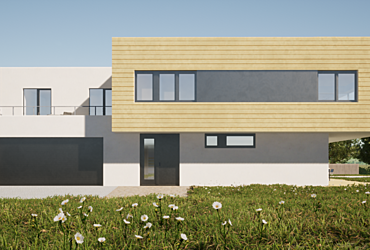
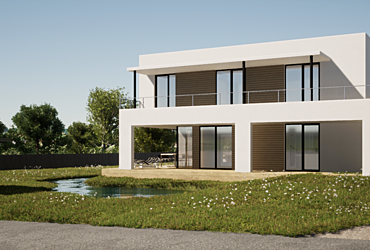
The result is a house made up of 4 or more 6.6x6.6 meter modules, expandable by 1.5x1.5 meters, erected with a wood structure for the walls and the roof; the walls are filled by 40x30x20 hemp bricks and connected by windowed passages that foster ventilation and optimise internal lighting, creating a patio that separates the day part from the night part.
The resulting outdoor spaces are occupied by bushes and low trees in order to filter the outside air when the corridor windows are open.
With a height of the internal rooms of the modules of 2.55 meters to contain the heat inside them, they are topped by a roof with traditionally built beams, designed with the aim of accumulating heat in winter and functioning as a solar chimney in summer; all governed by the convective motions created thanks to the contribution of the canals of the Canadian wells, located in the cooler northern external part of the plot where the building stands.
The openings are created following the pattern of the size of the bricks and in particular the windows have two types of doors: one designed for a short, but effective circulation or exchange of air and the second of a more traditional type.
The shutters are structures made up of horizontal wooden slats, fixed to the upper reinforced concrete curbs and folding upwards, so as to offer a brise-soleil effect in the summer period of maximum radiation and solar lighting.
Solar panels, wind turbines, rainwater collection tanks, external heat accumulators and a pyrolysis stove complete the technical equipment of the house.
As previously said, thanks to the flexibility of the modules, there are infinite variations and customisation possible, according to the customer's needs. The images presented here are just an example of one of the many solutions.
IMPORTANT NOTE: why this price?
Because it reflects the hours spent studying, researching, designing, rendering, and translating into images the main concept and mood in terms of the emotional perception of this project.
It is not a quick job, but one that requires many hours of commitment and effort.
All this to ensure that the building is first and foremost feasible, even from a technical point of view, and that it can meet the needs and tastes of those who purchase it.
The client's psychological and physical well-being (perception of the atmosphere, materials, spaces, light, the feeling of warmth and welcome both outside and inside, the degree of happiness, satisfaction, and personal fulfilment when observing the whole) is fundamental to the success of any architectural project.


 European Union